
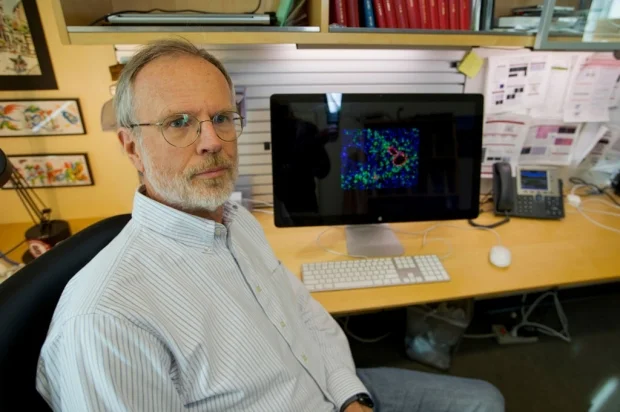
Roeland Nusse wins $3 million Breakthrough Prize
The developmental biologist was honored for helping to decode how Wnt signaling proteins affect embryonic development, cancer and the activity of tissue-specific adult stem cells that repair damage after injury or disease.
Roeland Nusse, PhD, the Virginia and Daniel K. Ludwig Professor in Cancer Research and a Howard Hughes Medical Institute investigator, was honored this evening with a 2017 Breakthrough Prize in Life Sciences.
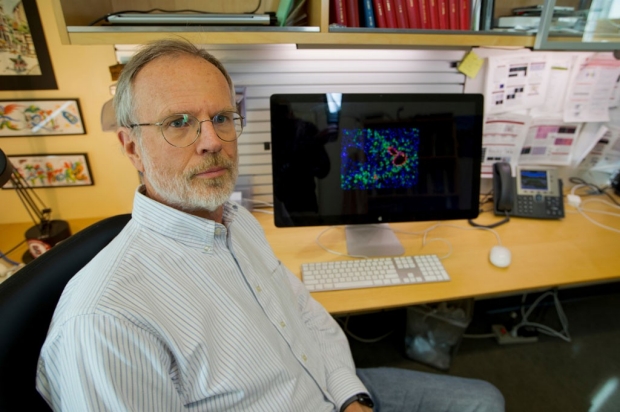
Roeland Nusse was awarded the 2017 Breakthrough Prize in Life Sciences for his contributions to the understanding a signaling molecule called Wnt.
Norbert von der Groeben
Nusse was awarded the $3 million prize for his contributions to the understanding of how a signaling molecule called Wnt affects normal development, cancer and the functions of adult stem cells in many tissues throughout the body.
“This is a complete surprise,” said Nusse, who is professor and chair of developmental biology. “My gratitude goes out to many people — my past and present postdoctoral scholars and graduate students and my former mentors have all contributed to the success of my research. The research and collaborative environment at Stanford and the long-term support from the Howard Hughes Medical Institute have also been fantastic. I see this award as a great honor for the entire community.”
The Breakthrough Prizes, initiated in 2013, honor paradigm-shifting research and discovery in the fields of life sciences, fundamental physics and mathematics. In total, about $25 million was awarded this year. A black-tie, red-carpet ceremony for the presentation of the prizes was held at the NASA Ames Research Center in Mountain View. The event was hosted by actor Morgan Freeman. The Grammy Award-winning pop star Alicia Keys provided entertainment.
“Roel’s pioneering work has provided deep insights into an essential molecular signaling pathway that controls normal embryonic development and adult tissue repair, and that contributes to cancer when it is not properly regulated. His work has served as a model for many others in our field and accelerated further studies of these critical processes,” said Stanford President Marc Tessier-Lavigne, PhD. “We are grateful that the Breakthrough Prize recognizes the work of scientific leaders who are inspiring others to pursue discovery that is truly transformative, benefiting all of humanity.”
His work has been the foundation of much of modern developmental biology.
Nusse’s interest in Wnt began in the 1980s as a postdoctoral scholar in the laboratory of Harold Varmus, MD, who was then on the faculty of UC-San Francisco. In 1982, Nusse discovered the Wnt1 gene, which was abnormally activated in a mouse model of breast cancer. He subsequently discovered that members of the Wnt family of proteins also play critical roles in embryonic development, cell differentiation and tissue regeneration.
“Roel has devoted his career to identifying one of the major signaling molecules in embryonic development, and clarifying its role in cancer development and in tissue regeneration,” said Lloyd Minor, MD, dean of the School of Medicine. “The importance of Wnt signaling in these processes cannot be overestimated. His work has been the foundation of much of modern developmental biology, and we are very proud of his contributions.”
Nusse’s more recent work has focused on understanding how Wnt family members control the function of adult stem cells in response to injury or disease. In 1996, he identified the cell-surface receptor to which Wnt proteins bind to control cells’ functions, and in 2002 he was the first to purify Wnt proteins — an essential step to understanding how they work at a molecular level.
“My work has shifted significantly over the years due to the influence of my Stanford colleagues, although it has always been focused on Wnt,” said Nusse. “When I arrived at Stanford, I was studying the involvement of the Wnt proteins in mouse development and cancer. I then switched to fruit flies, and then to the study of adult stem cells. Stanford has supported me during this evolution of my research career.”
Nusse’s lab is currently devoted to understanding how Wnt signaling affects the function of adult stem cells in the liver to help the organ heal after injury, as well as what role Wnt signaling might play in the development of liver cancer.
“The Breakthrough Prizes are a sign of the times,” said Nusse. “Together with the recently announced Chan Zuckerberg Initiative, they show how the wealth of Silicon Valley is now making an impact not just in the field of computer science, but also in biomedical fields. This is very exciting.”
The Breakthrough Prizes are a sign of the times.
Nusse is a member of the Ludwig Center for Cancer Stem Cell Research and Medicine at Stanford, of the Stanford Cancer Institute and of the Stanford Institute for Stem Cell Biology and Regenerative Medicine. He was awarded the Peter Debye Prize from the University of Maastricht in 2000. He is a member of the U.S. National Academy of Sciences, the European Molecular Biology Organization and the Royal Dutch Academy of Sciences. He is also a fellow of the American Academy of Arts and Sciences.
Seven $3 million Breakthrough Prizes — five in the life sciences, one in fundamental physics and one in mathematics — were awarded to 12 recipients. In addition, a special Breakthrough Prize in fundamental physics was awarded to the more than 1,000 researchers who proved the existence of gravitational waves in February of 2016.
By KRISTA CONGER
Krista Conger is a science writer for the medical school's Office of Communication & Public Affairs. Email her at kristac@stanford.edu.
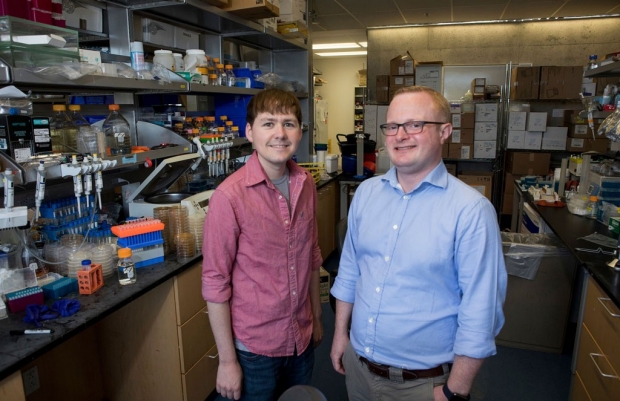
Prions can pass on beneficial traits, study finds
Researchers have found nearly 50 helpful prions in yeast and comparable proteins in humans, suggesting that this dreaded protein type can boost survival and plays a role in evolution.
Prion proteins, best known as the agents of deadly brain disorders like mad cow disease, can help yeast survive hard times and pass the advantageous traits down to their offspring, according to a new study by researchers at the Stanford University School of Medicine.
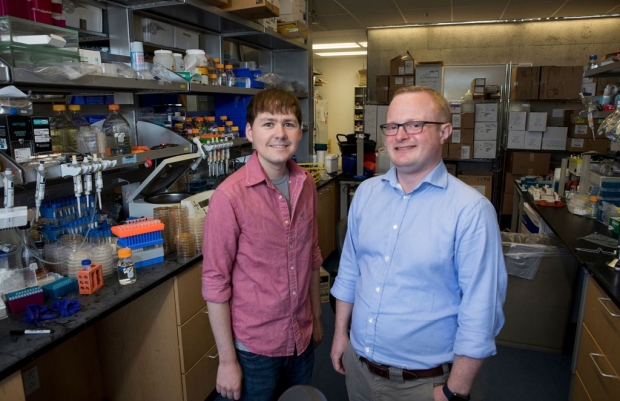
James Byers and Daniel Jarosz were part of a team that investigated how commonly traits in yeast are passed down by way of prion proteins instead of DNA.
Norbert von der Groeben
The study, published in the Oct. 6 issue of Cell and already available online, indicates that in yeast, and possibly other organisms, including humans, protein-based inheritance is more widespread than previously believed — and could play a role in evolution.
“In evolution there’s a paradox,” said Daniel Jarosz, PhD, assistant professor of chemical and systems biology and of developmental biology, who is lead author of the study. “We know that there are an extraordinary number of mechanisms that exist to protect the integrity of the genetic code and to assure that it’s faithfully passed on to future generations. But we also know that evolutionary success requires adaptability. How can you reconcile that need with the fact that the raw material for that innovation is really limited?”
Jarosz had a hunch that prions might be part of the answer. The new study suggests this could be the case.
How prions work
To understand his hunch, you need to know a bit about how prions work. Let’s consider this scenario in a bottle of beer on a hot summer day: When some of the yeast cells floating in your beer get stressed, in this case by the blazing sun, they begin producing large quantities of proteins called molecular chaperones — or proteins that help other proteins fold. These chaperones wrap around prions and fold them into a shape that kicks off a chain reaction of sorts. Other prions of its kind follow suit, using the original as a template.
“I sometimes liken it to a spreading fashion trend among teenagers,” said Jarosz. “Once it catches on with a couple of kids it spreads rapidly to other teenagers. But only teenagers.”
The upshot is that a single prion can quickly convert many others to assume the same shape — and since a protein’s shape dictates its behavior, that means the prion converts the other proteins’ behavior as well. Furthermore, when a cell divides, both new cells are likely to carry prion proteins that will continue to spur conversions. That means the offspring will also display the new behavior, a result of inheritance perpetuated not through the standard means of DNA but instead by way of proteins.
In the case of mad cow disease, a prion leads its normal brethren to fold in a way that leads to tissue damage in the brain and spinal cord of cattle. A human version of the disease, called variant Creutzfeldt-Jakob disease, can result from eating beef products from infected cattle.
They’re not all bad
But Jarosz knew that not all prions are bad. He had learned about a few beneficial ones from his time as a postdoctoral scholar at the Whitehead Institute for Biomedical Research in the laboratory of Susan Lindquist, PhD, a co-author of the study who has pioneered investigations of prions as a driver of inheritance. When Jarosz came to Stanford as an assistant professor in 2013, he began what would become a nearly three-year project to systematically assess an organism for prion-based inheritance. He chose yeast, he said, because researchers around the world have established the organism’s genetics and have developed comprehensive tools to analyze them.
“I wanted to know the breadth of protein-based inheritance across the yeast genome. Is it really so rare?”
With the help of several robots, his team overexpressed nearly every yeast gene, one by one, for 48 hours — triggering each gene to create 10 to 100 times more copies than usual of the protein designated by its code. Of the 5,300 genes they revved up, they found 46 made proteins that led to traits that remained heritable many generations after their expression had returned to normal. The traits were generally beneficial, such as resistance to temperature stress and anti-fungal drugs, or enhanced growth at high temperatures.
When they analyzed the proteins’ shapes, they discovered that few of them resembled what researchers had expected prions to look like. Most previously known prions fold in such a way that they pack tightly together and form long fibrils. The newly discovered prions lacked that trait, but many had others in common: They were strongly attracted to DNA molecules and they featured long, floppy “arms” able to fold in a wide variety of ways.
Non-Mendelian inheritance
Digging up unknown prions in yeast is less dangerous than you might think, said Jarosz. The efficiency of cross-species templating is very low for prion proteins. “This is probably one of the major reasons that mad cow disease wasn’t more widespread,” he said. “There is a safety concern with the human proteins. But luckily, simple procedures, like treating with bleach or soaking in sodium hydroxide, can render these protein conformations harmless.”
The team also found that the traits followed prionlike inheritance patterns. For example, unlike traits resulting from most genetic mutations, prion traits are dominant, and they don’t obey Mendel’s laws. Rather than being passed to half of all progeny in genetic crosses — as Mendel saw with his peas — prion-based traits are transmitted to every cell.
I sometimes liken it to a spreading fashion trend among teenagers.
Additionally, when the researchers temporarily inhibited chaperone proteins, the prion-based traits were permanently eliminated.
For the ultimate test, the researchers destroyed the DNA in the yeast cells carrying what they believed were prion-based traits, collected the remaining cell contents and introduced it into ordinary yeast cells. They found the traits were transmitted even though the cell’s DNA had been destroyed — indicating that proteins were transmitting the traits instead.
The researchers also found several human genes that would make proteins with similar characteristics. “These domains have been widely conserved across evolution, and several human homologs had the capacity to fuel protein-based inheritance,” they wrote in the study. “Our data thus establish a new and common type of protein-based molecular memory through which intrinsically disordered proteins can drive the emergence of new traits and adaptive opportunities.”
The work is an example of Stanford Medicine’s focus on precision health, the goal of which is to anticipate and prevent disease in the healthy and precisely diagnose and treat disease in the ill.
Other Stanford co-authors are James Byers and Richard She, both graduate students in Jarosz’s lab; David Garcia, PhD, postdoctoral scholar; Laura Lee, a graduate student formerly in Jarosz’s lab who is now working with professor of biology Dominique Bergmann, PhD; and former Amgen summer student Brayon Fremin, who is now a graduate student in the lab of Ami Bhatt, MD, PhD, assistant professor of medicine and genetics.
Researchers from the Whitehead Institute for Biomedical Research and MIT also co-authored the study.
The research was supported by the National Institutes of Health (grants R00GM098600, NIHDP2GM119140, T32GM007790, F32GM109680), the Ford Foundation, the Searle Scholars Program, the Sidney Kimmel Foundation, the David and Lucile Packard Foundation, the Howard Hughes Medical Institute, the Harold and Leila Mathers Charitable Foundation, the Eleanor Schwartz Charitable Foundation, the Broodbank Fellowship at the University of Cambridge, a Stanford Graduate Fellowship and the Stanford Summer Research Program/Amgen Scholars Program.
Stanford’s Department of Chemical and Systems Biology also supported the work.
By ROSANNE SPECTOR
Rosanne Spector is the editor of Stanford Medicine magazine for the medical school’s Office of Communication & Public Affairs. Email her at manishma@stanford.edu.